How to Calculate GST Challan Amount: Formula, ITC Set-Off & Examples (2026)
Himanshu
Last reviewed: 25 October 2026GST 2.0 (From 22 Sept 2025)Indian Retail & Tax Analyst • SalesToolkit Editorial
Every month, a registered business has to answer one question before the due date: how much GST do I actually have to pay? The amount you pay through a GST challan is not simply the tax you charged your customers. It is that tax minus the credit you are allowed to claim on your purchases, and the order in which that credit is adjusted matters.
This guide explains how to calculate the GST challan amount step by step, with worked examples in rupees, the rules for adjusting input tax credit (ITC), how interest works if you pay late, and how to create the challan on the GST portal. It is written for shopkeepers, traders, small manufacturers, service providers and anyone who files GSTR-3B.
The Short Answer: The GST Payable Formula
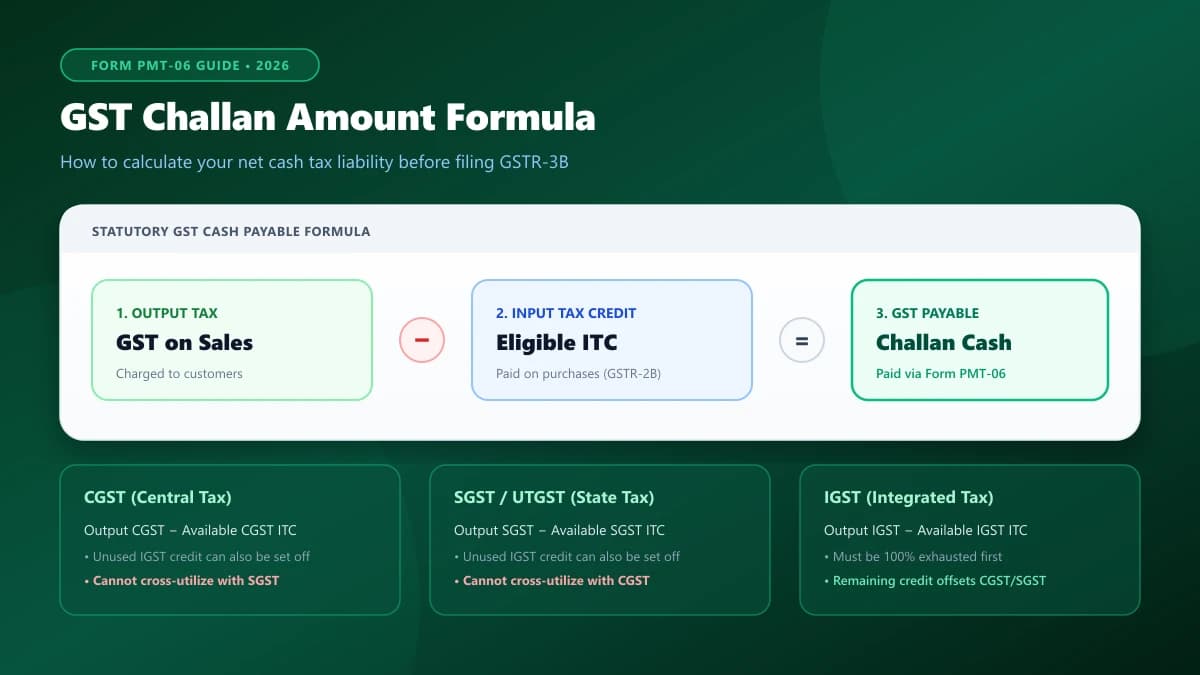
Statutory GST Cash Payable Formula:
GST payable in cash = Output tax (on your sales) − Input tax credit (on your purchases)
The calculation is done separately for each tax head: CGST, SGST/UTGST and IGST. If the result for a head is positive, that is what you pay in cash. If it is zero or negative, you pay nothing in cash for that head, and any leftover credit carries forward.
What Is a GST Challan?
A GST challan (form PMT-06) is the payment slip you generate on the GST portal to deposit money into your electronic cash ledger. You then use that cash ledger balance to pay your tax liability while filing GSTR-3B.
A few points worth knowing:
- The challan has a unique number called the CPIN, and it is generally valid for 15 days from the date it is generated.
- You can pay by net banking, NEFT/RTGS, or over the counter at an authorised bank, depending on what the portal offers.
- The challan has separate columns for tax, interest, penalty, late fee and others, across each tax head.
- Money in the cash ledger is only used when your tax liability is not fully covered by your ITC.
Step 1: Work Out Your Output Tax
Output tax is the GST you charged on your taxable sales during the month. For each invoice, GST is calculated on the taxable value (the price before GST).
GST amount = Taxable value × GST rate ÷ 100
If your sale is within the same state, the tax splits equally into CGST and SGST. If it is to another state, the whole amount is IGST. Add up the output tax for all invoices, grouped by tax head (or compute them in seconds using our free online GST calculator). If you need a refresher on rates, our guide to GST rates in India lists the current slabs, and our post on the difference between CGST, SGST and IGST explains which one applies when.
Also subtract GST on credit notes and add GST on debit notes for the month, as these change your output tax.
Step 2: Work Out Your Eligible Input Tax Credit
Input tax credit is the GST you paid on business purchases and expenses that you are allowed to set off against your output tax. Check these before claiming:
- You have a valid tax invoice from the supplier.
- The purchase appears in your GSTR-2B (the auto-generated statement of eligible credit).
- The goods or services were received and are used for business.
- The item is not on the list of blocked credits (for example, certain personal-use items or motor vehicles in many cases). When unsure, check with your accountant.
Only claim what is eligible. Over-claiming can lead to interest and penalty later.
Step 3: Adjust ITC in the Correct Order
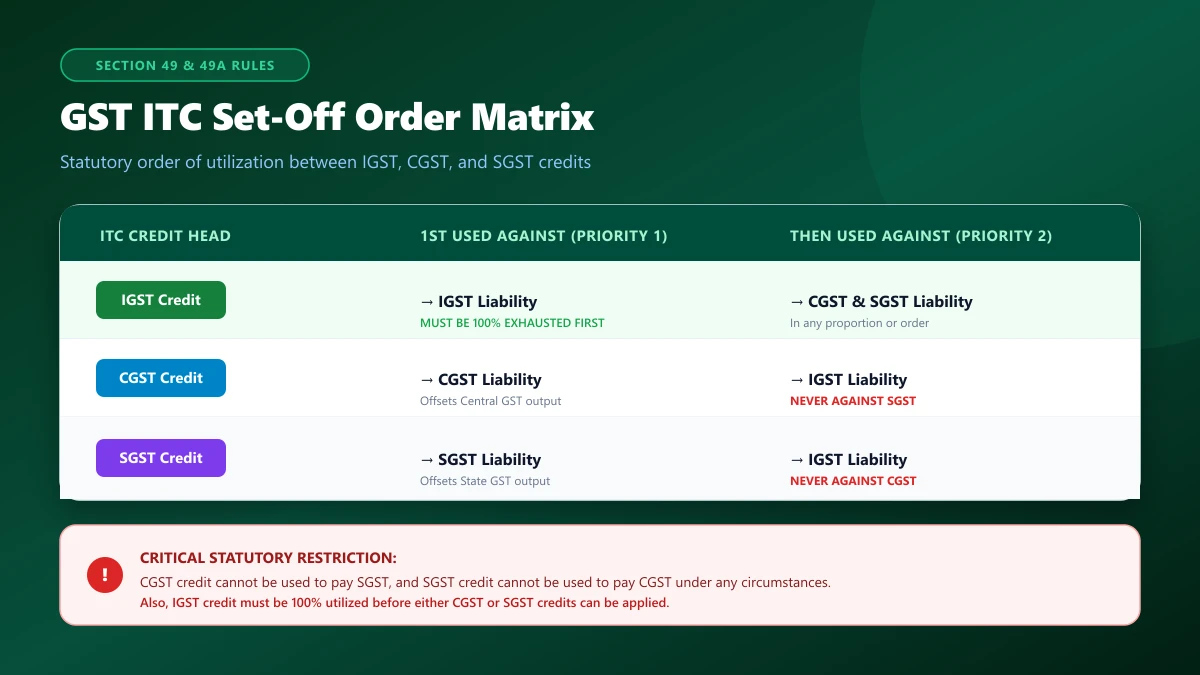
Credit of one head cannot be used freely for another. The utilisation rules are:
| Credit available | First used against | Then used against |
|---|---|---|
| IGST credit | IGST liability | CGST and SGST liability (in any order) |
| CGST credit | CGST liability | IGST liability |
| SGST credit | SGST liability | IGST liability |
The key restriction: CGST credit cannot be used to pay SGST, and SGST credit cannot be used to pay CGST. Also, IGST credit must be used up completely before you use CGST or SGST credit.
Step 4: Pay the Balance in Cash
After set-off, whatever liability remains in each head is the amount you must deposit through the challan. Deposit it in the cash ledger and use it while filing GSTR-3B.
Example 1: Simple Intra-State Trader
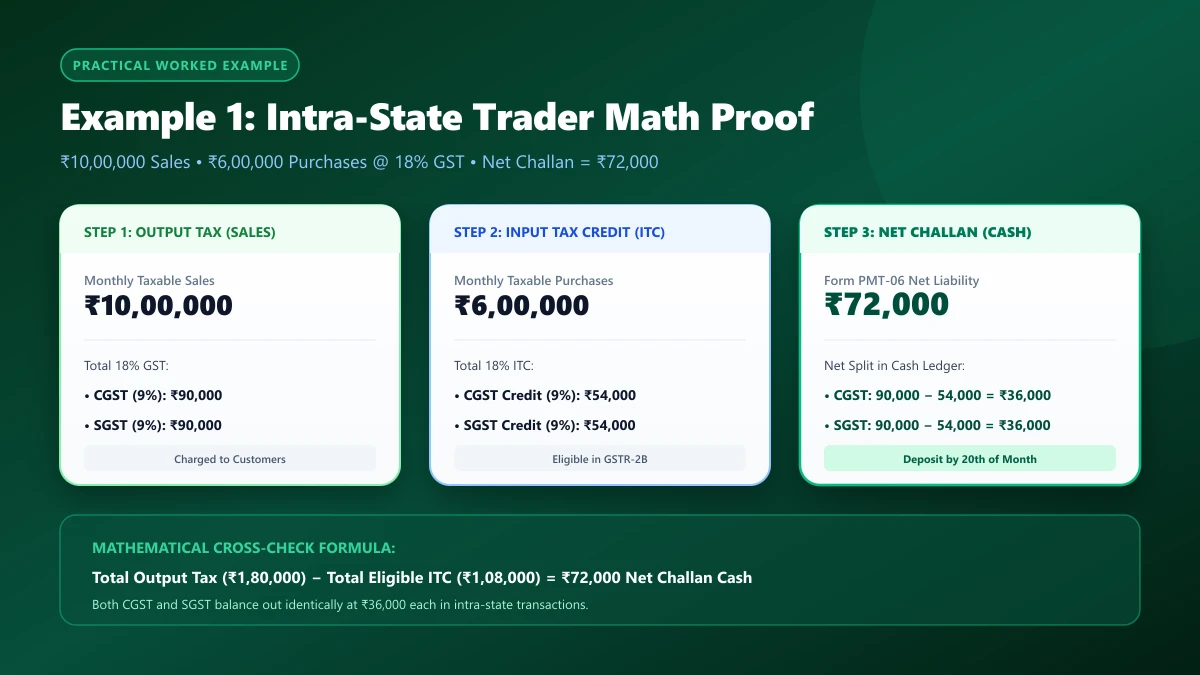
A trader sells goods only within the same state at 18% GST.
- Taxable sales for the month: ₹10,00,000
- Output GST = 10,00,000 × 18% = ₹1,80,000, split as CGST ₹90,000 and SGST ₹90,000
- Taxable purchases: ₹6,00,000 at 18% = ₹1,08,000, split as CGST credit ₹54,000 and SGST credit ₹54,000
Set-off:
- CGST payable = 90,000 − 54,000 = ₹36,000
- SGST payable = 90,000 − 54,000 = ₹36,000
GST challan amount = ₹36,000 + ₹36,000 = ₹72,000
A quick check: total output tax ₹1,80,000 minus total credit ₹1,08,000 equals ₹72,000.
Example 2: Business With Intra-State and Inter-State Sales
A business makes both local and out-of-state sales, and has credit in all three heads.
| Head | Output tax | ITC available |
|---|---|---|
| CGST | ₹50,000 | ₹15,000 |
| SGST | ₹50,000 | ₹10,000 |
| IGST | ₹20,000 | ₹30,000 |
Set-off in the correct order:
- IGST credit of ₹30,000 is first used against IGST liability of ₹20,000. IGST payable becomes ₹0, and ₹10,000 of IGST credit is left.
- The leftover ₹10,000 IGST credit is used against CGST liability (it could also go to SGST, in any order). CGST liability becomes 50,000 − 10,000 = ₹40,000.
- CGST credit of ₹15,000 is used against the remaining CGST liability: 40,000 − 15,000 = ₹25,000.
- SGST credit of ₹10,000 is used against SGST liability: 50,000 − 10,000 = ₹40,000.
GST challan amount = ₹25,000 (CGST) + ₹40,000 (SGST) = ₹65,000
Check: total output tax ₹1,20,000 minus total credit ₹55,000 equals ₹65,000.
Example 3: Interest on Late Payment
If you pay your net cash liability after the due date, interest applies. The rate is 18% per annum, calculated from the day after the due date until the date you actually pay.
Interest = Net tax paid late × 18% × Number of days late ÷ 365
- Net cash liability from Example 1: ₹72,000
- Paid 10 days late
- Interest = 72,000 × 18% × 10 ÷ 365 = about ₹355
There is also a daily late fee for filing GSTR-3B after the due date, even if the tax payable is nil. The amount and the cap depend on your turnover and the rules in force, so check the current figure on the GST portal or with your accountant.
Due Dates You Should Remember
- Regular monthly filers: GSTR-3B and payment are generally due by the 20th of the following month.
- QRMP scheme (quarterly return, monthly payment): the quarterly return has its own due date, and tax for the first two months is paid by the 25th of the next month using a challan, commonly through the fixed-sum method or self-assessment method.
- Composition scheme: the tax is a fixed percentage of turnover, paid quarterly with form CMP-08, and there is no ITC set-off. Rates differ by business type.
Due dates are sometimes extended by notification, so always confirm the current date on the GST portal.
How to Create a GST Challan on the GST Portal
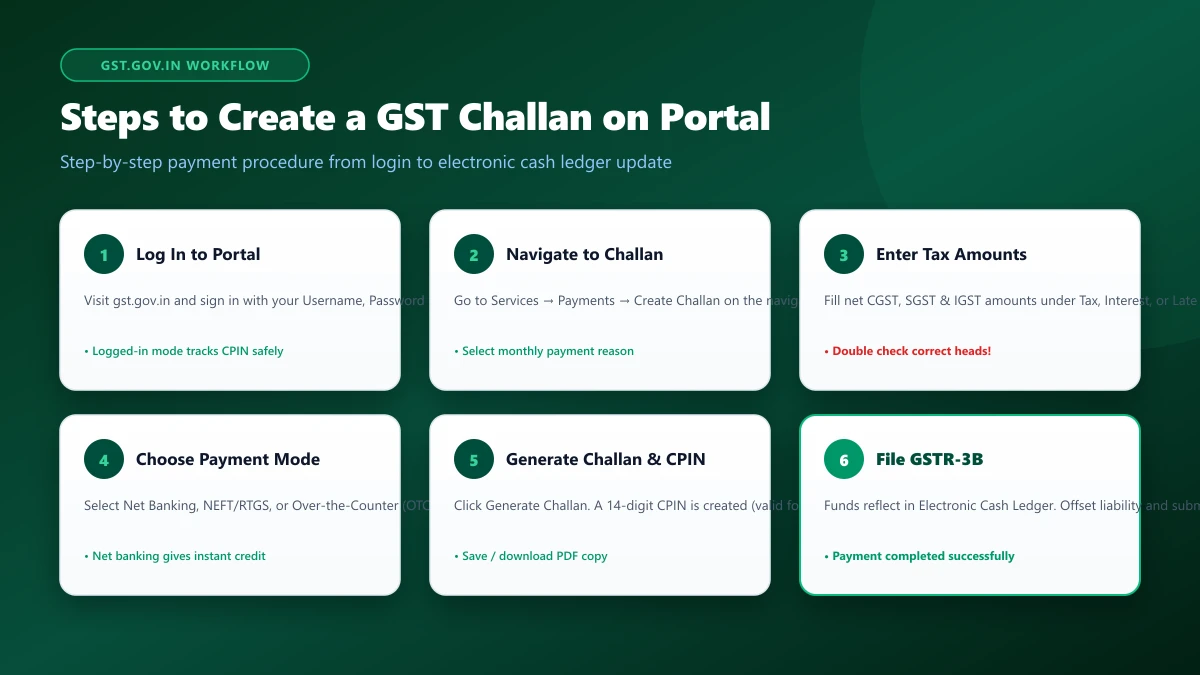
- Log in to the GST portal with your username and password.
- Go to Services → Payments → Create Challan.
- Choose the reason for payment, such as monthly or quarterly payment.
- Enter the amounts in the table for CGST, SGST/UTGST and IGST under the tax, interest, penalty, fee and others columns. Many users can use the portal's liability-based option to see the amount due.
- Select the payment mode (net banking, NEFT/RTGS or over the counter) and generate the challan.
- Complete the payment and note the CPIN. Once the amount reaches the cash ledger, use it while filing GSTR-3B.
For the exact screens, always follow the latest layout on the portal, as it is updated from time to time.
Common Mistakes When Paying GST
- Using gross value instead of taxable value. GST is calculated on the price before tax, not on the invoice total that already includes GST. Our guide on GST inclusive vs exclusive pricing shows how to separate the two.
- Claiming ITC that is not in GSTR-2B. Credit for purchases the supplier has not reported can be questioned later.
- Setting off CGST credit against SGST. This is not allowed. Match heads correctly.
- Forgetting credit and debit notes. They change your output tax for the month.
- Paying after the due date. Interest and late fees add up quickly.
- Depositing in the wrong head. A cash payment made in the wrong head can be hard to correct, so double-check CGST, SGST and IGST before paying.
- Not reconciling before filing. Compare your books with GSTR-2B and your sales register each month.
Monthly GST Payment Checklist
- Total taxable sales grouped by rate and by CGST, SGST and IGST
- Credit and debit notes adjusted
- Eligible ITC checked against GSTR-2B
- ITC set off in the correct order
- Net cash liability for each head noted
- Challan created and paid before the due date
- GSTR-3B filed and the payment reference saved
Calculate GST Faster With Our Free Tool
Working out GST on every invoice by hand takes time and invites mistakes. Use our free GST Calculator to add or remove GST from any amount in seconds, and then plug the totals into the formulas above. For a wider introduction to how GST works, read our guide on the GST calculation formula.
Final Thoughts
Once you separate the work into four steps, the GST challan amount is straightforward: calculate output tax, confirm eligible credit, set it off in the permitted order, and pay the balance by the due date. Keep your sales and purchase records tidy, reconcile with GSTR-2B every month, and use the examples above as a template.
Disclaimer: This article is for general information and uses sample numbers. GST rates, due dates, late fees and procedures change from time to time. Please verify the current rules on the official GST portal or consult a qualified tax professional before filing.
Calculate GST in 1-Click (100% Free & Private)
Add or remove 0%, 3%, 5%, 18%, or 40% GST (GST 2.0) instantly. No signup required, zero server uploads.
Open Free GST CalculatorFrequently Asked Questions
How do I calculate GST challan amount?
Add up the GST you charged on sales (output tax), subtract the eligible input tax credit on your purchases, and deposit the balance in each tax head (CGST, SGST, IGST) through a challan. If the credit covers your whole liability, no cash payment is needed.
What is the formula for GST payable?
GST payable = Output tax − Input tax credit, worked out separately for CGST, SGST and IGST, after applying the ITC set-off order.
Can I use CGST credit to pay SGST?
No. CGST credit can be used against CGST and then IGST, and SGST credit against SGST and then IGST. They cannot be used against each other.
What is the due date to pay GST?
For regular monthly filers, GSTR-3B and the payment are generally due by the 20th of the next month. QRMP filers and composition taxpayers have different dates, and dates can change by notification, so check the GST portal.
What happens if I pay GST late?
Interest at 18% per annum applies to the net tax paid late, calculated for the days of delay. A late fee also applies if GSTR-3B is filed after the due date.
How long is a GST challan valid?
A generated challan is generally valid for 15 days. If you do not pay within that time, you need to create a new one.
Do I need to pay a challan if my ITC is more than my output tax?
No cash payment is needed for that head. The extra credit stays in your electronic credit ledger and can be used in later months, or claimed as a refund only in the specific cases the law allows.
What is the difference between a GST challan and GSTR-3B?
The challan is the payment slip used to deposit money into the cash ledger. GSTR-3B is the monthly return in which you declare your sales and credit and pay the tax from your ledgers.
Can I pay GST without logging in?
The portal has a facility to generate a challan without logging in, but a logged-in challan is easier to track and links to your account details. Use the option that suits your case.